IDN Punycode Converter: Convert International Domain Names Online
Created on 22 September, 2026 • Text tools • 41 views • 7 minutes read
Domain names are usually written with standard English letters, numbers, and hyphens. However, people around the world use many writing systems, including Burmese, Chinese, Arabic, and Cyrillic. Internationalized Domain Names (IDNs) make it possible to represent domain names using characters from different languages.
The Domain Name System (DNS) uses a compatible ASCII representation for internationalized domain labels. This representation is commonly called Punycode. An IDN Punycode Converter helps users convert international domain name text into its Punycode form and, where supported, convert Punycode back into readable Unicode text.
The Urlshorta IDN Punycode Converter is a convenient place to start when you need to examine or convert internationalized domain name text.
What Is an Internationalized Domain Name (IDN)?
An Internationalized Domain Name is a domain name that includes characters outside the basic ASCII character set. These characters may come from different languages and writing systems, allowing people to use domain names that are more familiar to their communities.
For example, a domain label may contain Chinese characters, Arabic characters, or letters with diacritical marks. IDNs help make domain names more accessible to users who do not normally write in English.
Although IDNs can display Unicode characters, their DNS-compatible representation uses an encoding process defined for internationalized domain names. Punycode is an important part of that process.
What Is Punycode?
Punycode is an encoding system used to represent Unicode text using a restricted ASCII character set. In the context of internationalized domain names, an encoded label commonly begins with the prefix
xn--
.
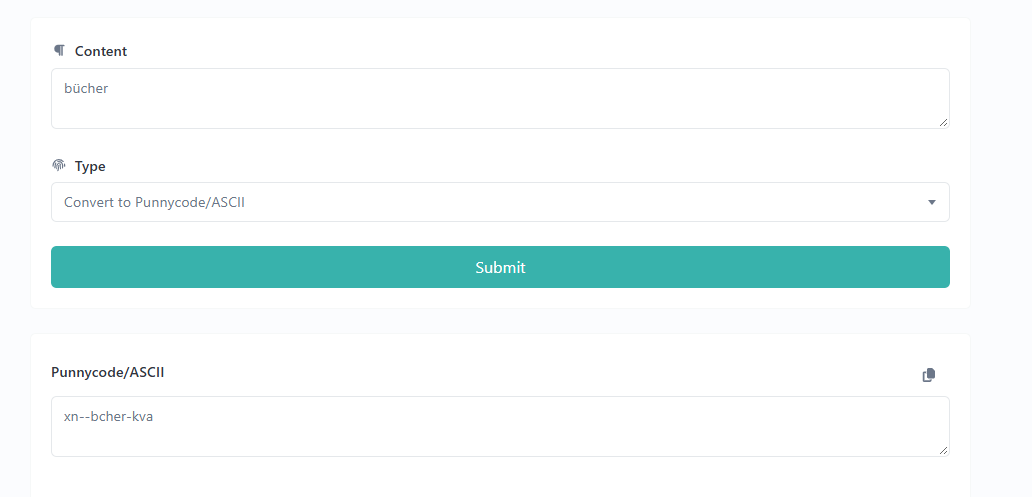
For example, the Unicode domain label
bücher
is represented in Punycode as
xn--bcher-kva
.
This conversion allows domain labels containing international characters to be represented in a form compatible with the traditional DNS naming system.
Punycode does not translate a domain name from one language to another. It encodes the characters so that the domain label can be represented using ASCII characters.
How to Use the IDN Punycode Converter
You can use an IDN Punycode Converter to inspect internationalized domain names without manually calculating the encoded representation.
Step 1: Open the Converter
Visit the
IDN Punycode Converter on Urlshorta
.
Step 2: Enter Your Domain Name
Enter the internationalized domain label or domain name you want to convert. For example, you can test a label containing accented characters or another supported Unicode writing system.
Step 3: Choose the Conversion Direction
If the tool supports both directions, choose Unicode to Punycode to encode international characters, or Punycode to Unicode to decode an encoded label into readable text.
Step 4: Review the Result
Check the converted output carefully. If you are processing a complete domain, confirm that the domain labels and separators remain correct.
Step 5: Copy the Converted Text
Copy the output for documentation, development, testing, or domain-name analysis. If you plan to register or visit a domain, verify the result before using it.
Practical Examples of IDN and Punycode Conversion
The following examples illustrate how Punycode represents internationalized domain labels.
Example 1: A Domain Label with an Accented Character
Unicode label:
bücher
Punycode label:
xn--bcher-kva
The encoded form represents the original label in an ASCII-compatible format. It does not change the meaning of the word through translation.
Example 2: Understanding the xn-- Prefix
Consider the label:
xn--bcher-kva
The
xn--
prefix identifies an ASCII-compatible encoding used for an internationalized domain label. A Punycode decoder can convert the encoded label back to its Unicode representation when the input is valid.
Not every string beginning with
xn--
is necessarily a valid, correctly processed domain label. Validation is important when checking actual domain names.
Example 3: Working with a Complete Domain
A domain may contain several labels separated by periods, such as a subdomain, registered domain, and top-level domain.
When converting a complete internationalized domain, each relevant label may need to be processed according to the applicable IDN rules. Do not assume that a converter performs every domain validation or registration check simply because it returns an encoded result.
Why Use an IDN Punycode Converter?
Website Development
Developers may need to inspect internationalized domain names when building applications that accept website addresses, validate domains, or work with DNS-related services.
A converter can help developers understand the ASCII-compatible form of a domain label and investigate unexpected input.
Domain Name Administration
Website owners and domain administrators may encounter Punycode when reviewing domain settings, registration information, or technical documentation.
Understanding the encoded form can make it easier to recognize when a domain uses international characters.
International Website Support
Businesses serving users in multiple countries may use domain names that reflect local languages. Punycode conversion helps technical systems work with those names while allowing users to recognize familiar characters where supported.
Technical Learning and Testing
Students and developers can use a converter to explore how Unicode characters are represented in internationalized domain labels. It can also help when testing domain-processing functions and comparing Unicode input with ASCII-compatible output.
IDN Punycode Conversion vs. URL Encoding
Punycode and URL encoding solve different problems, even though both can appear in web addresses.
Punycode
Punycode is used to represent internationalized domain name labels in an ASCII-compatible form. For example, the label
bücher
can be represented as
xn--bcher-kva
.
URL Encoding
URL encoding represents certain characters in a URL using percent-encoded sequences. For example, a space is commonly represented as
%20
in a URL component.
Punycode should not be used as a substitute for URL encoding, and URL encoding does not replace the IDN processing required for internationalized domain names.
Security Considerations When Working with IDNs
Internationalized domain names improve language accessibility, but they can also create opportunities for visual impersonation.
Beware of Lookalike Characters
Characters from different writing systems can look similar. A malicious domain may use visually confusing characters to imitate a familiar brand or website.
For this reason, a domain that looks correct at first glance should not automatically be considered trustworthy.
Punycode Does Not Prove That a Domain Is Safe
Converting a domain to Punycode only changes its representation. It does not check whether the website contains malware, steals credentials, or impersonates another organization.
Use additional security checks and verify the domain through trusted sources before entering sensitive information.
Validate Domains Before Using Them
If you develop an application that accepts IDNs, use established IDN processing libraries and follow the relevant domain validation rules. Do not rely on a simple conversion alone to decide whether a domain is valid or safe.
Common IDN Punycode Conversion Problems
Invalid Input
Some strings cannot be decoded as valid Punycode or may not satisfy the applicable IDN rules. If a conversion fails, check for typing errors and confirm that the input uses the expected format.
Unexpected Characters
Unicode text can contain combining marks or characters that are visually similar but technically different. Normalization and validation may be necessary when handling domain names programmatically.
Different Display and Encoded Forms
A browser or application may display an internationalized domain in Unicode or Punycode depending on its security policies and implementation. A difference in appearance does not necessarily mean that the underlying domain has changed.
Frequently Asked Questions
What does an IDN Punycode Converter do?
It converts internationalized domain name text between Unicode and its Punycode representation, depending on the conversion options supported by the tool.
What does xn-- mean in a domain name?
The prefix
xn--
identifies an ASCII-compatible representation of an internationalized domain label using Punycode.
Does Punycode translate a domain into English?
No. Punycode encodes Unicode characters into an ASCII-compatible representation. It does not translate the domain name into another language.
Is Punycode the same as URL encoding?
No. Punycode represents internationalized domain labels, while URL encoding represents certain characters in URL components using percent-encoded sequences.
Can a Punycode domain be dangerous?
Punycode itself is not malicious. However, an attacker may use an internationalized domain name with visually similar characters to imitate a legitimate website. Always verify unfamiliar domains.
Can every Unicode string be converted into a valid domain name?
No. A string may be convertible at the character-encoding level but still fail domain-name validation requirements. Validity depends on the applicable IDN rules and the structure of the domain.
Conclusion
An IDN Punycode Converter makes it easier to understand how internationalized domain names are represented in a DNS-compatible format. It is useful for developers, website owners, domain administrators, and anyone learning about international domain names.
Punycode is an encoding system rather than a translation or security service. For reliable results, verify the converted text and use proper domain validation when working with real websites.
Try the
Urlshorta IDN Punycode Converter
to explore internationalized domain labels and their Punycode representations.
Categories
Popular posts
-
What Is a Gravatar Checker?Checker-tools • 90 views
-
-
-
-